AI Talk, Workshop or Training: Which Format to Choose?
“We’re organising a company seminar and we want to train our teams in AI.” Behind that request, I often hear several different needs: reassuring people who feel overwhelmed, giving colleagues from very different backgrounds a common language, or learning to use AI for a specific task.
All of these objectives make sense. But they call for different approaches. Before discussing duration or tools, I ask one question: what would you like participants to understand or be able to do by the end?
Here is how I distinguish an AI talk, a workshop and a training course, based on the situations I encounter in companies.
The choice in one minute
- An AI talk helps demystify the subject, communicate clear ideas and give a large audience a shared set of reference points.
- An AI workshop helps people apply advice and methods to concrete use cases, with time to experiment and discuss.
- An AI training course develops specific skills through a structured progression that includes practice and assessment.
These formats can complement each other. A workshop can be part of a training course. And a talk can be highly interactive without becoming a practical session on using the tools.
AI talk, workshop or training: a comparison
On mobile, scroll the table horizontally to compare the three formats.
| Criterion | AI talk | AI workshop | AI training course |
|---|---|---|---|
| Main objective | Understand, demystify and establish shared reference points | Apply a method to concrete cases | Develop defined skills |
| Participation | Active listening, questions, demonstrations and discussion | Experimentation, discussion and guidance | Progressive exercises and feedback on practice |
| Audience | Different roles and experience levels brought together around one subject | Participants with use cases to explore | Audience and prerequisites defined around the target skills |
| Group size | No fixed maximum; venue and participation arrangements need to be planned | Fewer than 40 people to protect discussion time and individual attention | Depends on the programme and level of support |
| Duration | In my sessions: 45 to 90 minutes, including questions and answers | Depends on the use cases and practice time required | Depends on the learning progression |
| Preparation | Context, audience profiles and priority messages | Concrete cases, access to tools and usage guidelines | Objectives, prerequisites, exercises and assessment |
| Desired outcome | Better understanding and more informed questions | A method tried out and practice discussed | A skill practised and learning assessed |
| Limitation to anticipate | Does not replace individual support with practical use | One successful attempt does not guarantee lasting proficiency | Requires time and a programme suited to the starting level |
Can an AI talk bring everyone up to the same level?
At a company seminar, participants rarely share the same role or relationship with AI. Some use it every day. Others mainly hear alarming claims about it, or do not yet see its relevance.
The aim is not to give everyone identical skills in an hour. It is to provide shared reference points so people understand what is being discussed. Beginners can get up to speed quickly. More experienced users can appreciate the clarity of the explanations and the opportunity to step back from their own habits.
I focus on a few key ideas: what generative AI produces, why an answer can seem convincing, and where human judgement still belongs. The content needs to remain accessible without becoming superficial.
At VINCI: demystifying AI to regain a sense of control
For an AI seminar at VINCI, the starting point was an audience with reservations, uncertainty about the tools’ real value and some anxiety fuelled by online discussions.
I designed the session to demystify AI and restore a sense of understanding: grasping the challenges ahead, regaining a feeling of control and feeling able to suggest possible uses.
David Facon later shared this review, translated from French:
“An incredible mentalism & AI experience. The advice on using AI is interesting. Amazing.”
This is the kind of need I address in my AI talks for businesses: helping a group engage with the subject before asking them to change how they work.
An AI workshop: moving from principles to a concrete use case
If your expectation is “everyone should try it and receive feedback”, I would point you towards a workshop. That changes the setup: you need to reserve time for practice, questions and each participant’s difficulties.
In my workshops, I start with concrete use cases to apply advice and methods. One aim is to understand the difference between using generative AI in a generic way and adapting it to what you actually want to achieve.
A vague request can produce an answer that reads nicely but is not particularly useful. The work is to clarify the need, provide relevant context and examine what the answer actually enables you to do. The tool becomes a support for thinking and experimenting.
I prefer groups of fewer than 40 people to leave room for discussion and individual attention. The duration then depends on the cases to be explored. Packing too many exercises into a short slot does not help people understand.
Before the workshop, you also need to check the practical conditions: which tools participants can access, whether accounts are available, internal guidelines and what data they are allowed to use. A good use case loses its value if nobody can try it.
An AI training course: developing a skill over time
Training becomes relevant when a company has a specific expectation: by the end of the programme, a person should be able to complete a task, assess its quality and understand its limitations.
The programme then needs a learning progression, exercises and a way to assess what has been learned. Its duration follows from that ambition, the starting level and the practice time required. The word “training” alone does not define the content.
When choosing a provider, I suggest asking: which skill will participants work on, how will they practise, and how will we know they have progressed? This takes the conversation beyond a simple list of tools to be presented.
Why I also draw on cognitive science
Tools evolve quickly. An interface or feature demonstrated today may change tomorrow. But how we place our trust, direct our attention and make decisions remains central to understanding our relationship with AI.
My approach connects artificial intelligence with these human mechanisms. Mentalism experiences serve as direct metaphors for the concepts being discussed. They give the audience a situation to experience and question, rather than adding an entertainment segment unrelated to the message.
The aim is to develop a way of thinking: why did I find that answer credible? What did I check? How much of my judgement am I handing over? Those questions remain useful when the tool changes.
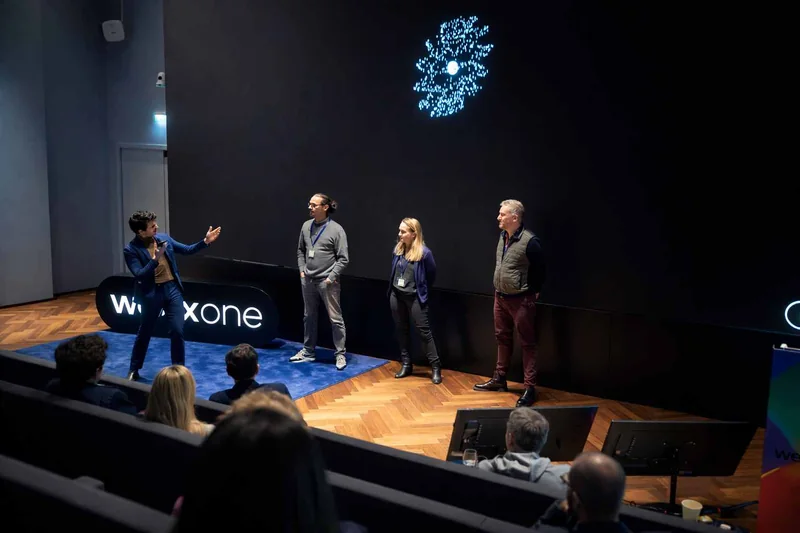
At BPCE: maintaining attention during a virtual talk
For a hybrid learning week at BPCE, I delivered a virtual talk to an audience with varied profiles. The content needed to address their concerns while taking remote attention into account.
I tailored the session around the audience’s typical profiles and used mentalism experiences that could work over video. The interaction and playful elements supported the concepts being explained. A remote talk can include real moments of participation, rather than simply reproducing a stage presentation in front of a camera.
Can you combine a talk and a workshop?
Yes, when each session has a clear purpose. A talk can open the seminar and establish a common language. Workshops can then give smaller groups the chance to work on their own use cases.
I suggest starting with what participants need to understand before practising, then deciding what they should try. A shared debrief can also bring out the questions they encountered. The value comes from how the sessions connect, not from the number of formats on the programme.
Three mistakes to avoid in your brief
- Asking to “train everyone in AI” without specifying the objective. Distinguish between understanding, trying something out and acquiring a skill.
- Starting with a list of tools. Start with work situations and the audience’s questions, then choose useful examples.
- Forgetting what happens afterwards. Identify the resources, people or practice opportunities that will help teams continue.
Questions to consider
Does every participant need a computer?
Usually not for a talk. For a workshop where everyone needs to use the tools, equipment and access must be arranged. The setup depends on the exercises selected.
Should beginners and regular users be separated?
Not necessarily. A talk can bring these groups together around shared reference points. For practical work, cases or groups suited to different levels can prevent some people from waiting while others disengage.
What should you share before requesting a proposal?
The objective, participants’ profiles, group size, available time, date and whether people will attend in person or remotely. Include the questions your teams are already asking: they are often more useful than a predetermined list of tools.
Planning a company seminar or learning week? Let’s define what you want to make possible for your teams, then choose the format that serves that objective.
Discuss the right format for your team
Isma Zmerli, AI keynote speaker, engineer, cognitive science graduate and mentalist.
