In-Person or Virtual Keynote: Which Format to Choose?
“Does it work on a video call too?” I hear this question for remote learning weeks, for holiday parties that bring together two offices in two countries, or when the budget does not allow everyone to travel to the same place.
My answer: yes, on one condition. A virtual talk should not be a stage talk in front of a camera. The format changes, and so does the way you hold attention.
Here is how I compare in-person, virtual and hybrid formats, based on the sessions I prepare for companies. To choose between a talk, a workshop and a training course, see also my comparison of AI session formats.
The choice in one minute
- In person to create a shared highlight: the energy of a room, surprise spreading through the audience, conversations that continue after the session.
- Virtual to bring together teams spread across several sites or countries, with no travel, in a short time slot.
- Hybrid when part of the audience is in the room and part is online, as long as both truly take part.
All three can work. The real question lies elsewhere: what should your participants experience during that moment?
In-person, virtual or hybrid: a comparison
On mobile, scroll the table horizontally to compare the three formats.
| Criterion | In person | Virtual | Hybrid |
|---|---|---|---|
| What the audience experiences | An emotion shared by the whole room | An experience lived by each person at home, at the same moment | Two audiences to connect |
| Attention | Carried by the group’s energy | Fragile: it has to be renewed constantly | Uneven between the room and the screens |
| Interaction | Volunteers on stage, reactions from the room | Chat, cameras, experiences lived from each screen | To be planned for both audiences |
| Group size | From a team meeting to a plenary | From about ten people to several hundred | Depends on the room and the platform |
| Logistics | Venue, AV, travel, accommodation | A link, a platform and a technical check | Both, plus an AV team to connect room and remote |
| Ideal length | 30 to 90 minutes | 15 to 60 minutes | As in a room, with prompts for the remote audience |
| Strengths | Energy, shared memories, informal moments | Several sites together, no travel, quick to set up | Including those who cannot attend |
| Limit to anticipate | Getting everyone to the same place | Screen fatigue and the pull of other tabs | Remote participants become spectators |
The strengths of an in-person talk
A room creates something no screen fully replaces: a collective reaction. When a mentalism experience surprises people, the surprise spreads from one row to the next. People laugh together, look at each other and talk about it afterwards.
In person also allows the most spectacular formats: volunteers on stage, close-up magic between tables, a full show after a talk.
- Group energy that carries attention.
- Experiences with volunteers on stage.
- Informal conversations before and after the session.
Its limit is simple: everyone has to be in the same place, with the time, travel and budget that involves.
The strengths of a virtual talk
Virtual sessions reflect a reality: many teams no longer work in the same place, and international companies rarely gather everyone in one room.
- Bring several sites or countries together in the same session.
- Remove travel: less time, less budget and a smaller carbon footprint.
- Fit into a working day, in 15 to 60 minutes.
- Organise faster: no venue to book, no heavy logistics.
- Choose the language: English or French for international teams.
Its limit fits in one word: attention.
The real challenge of virtual talks: attention
In a room, the presence of others holds attention. Remotely, nothing holds it: cameras off, notifications, open tabs. Even an excellent talk, filmed, is watched from a distance.
This is where mentalism makes the difference. It is not watched, it is experienced. Each participant thinks of a word, makes a choice, writes something on a sheet of paper, then discovers the result live, at the same moment as their colleagues. The surprise is shared, even through screens.
In my AI talks, each experience serves an idea: why a well-phrased answer convinces us so quickly, how our attention can be guided, where our judgement remains essential. Participants experience it first, then understand how it works. That is what turns a virtual talk into an interactive moment.
At BPCE Assurances: a virtual AI learning week
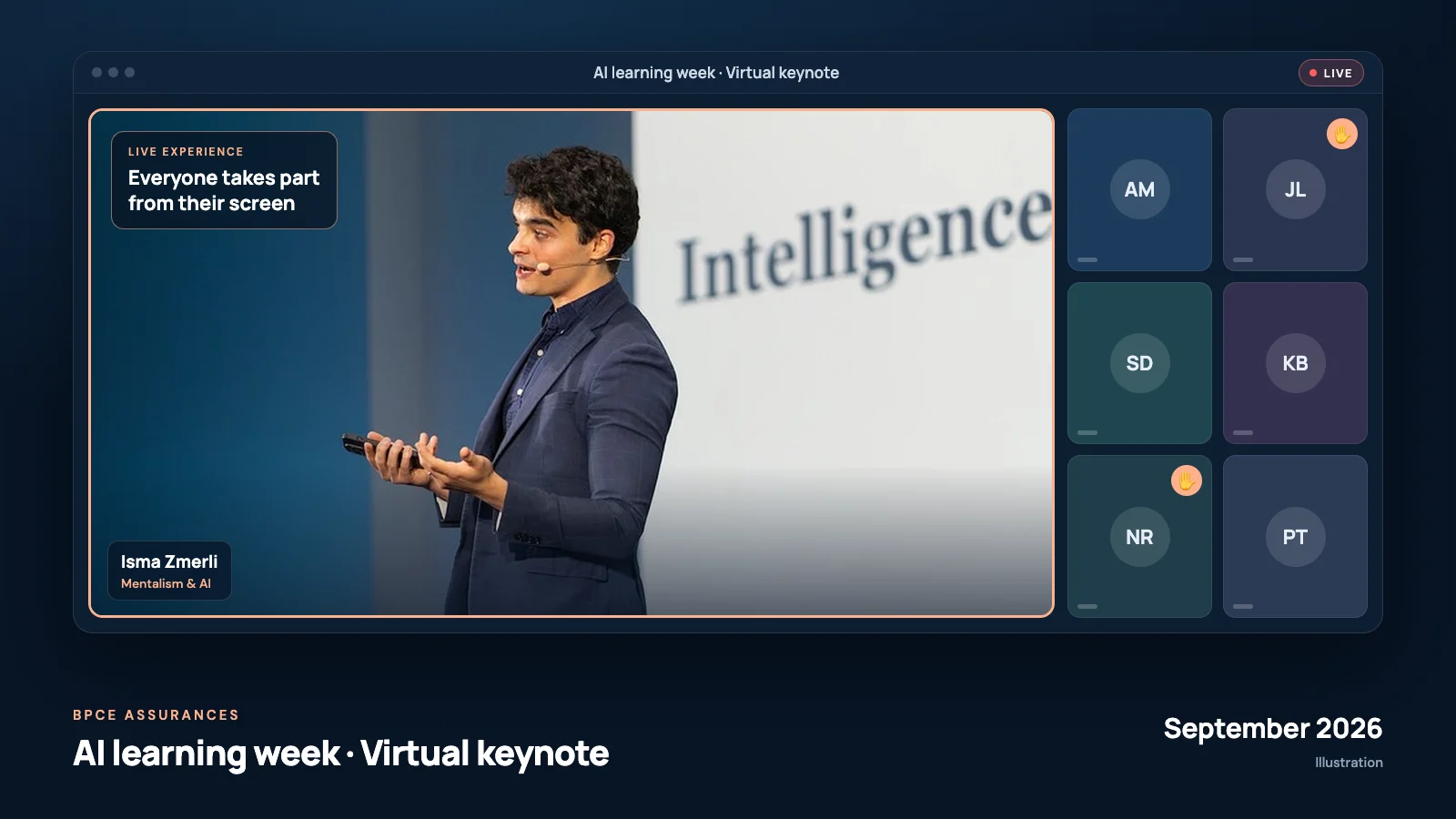
For the BPCE Assurances learning week in September 2026, I delivered a virtual talk to an audience with varied profiles. The content had to address their concerns while taking remote attention into account.
I built the session around the audience’s typical profiles, with mentalism experiences designed for video. Interaction and play supported the ideas being explained: real moments of participation, rather than a stage presentation in front of a camera.
What about hybrid?
Hybrid brings together a room and remote participants. It is often the most inclusive option, and the most delicate. The trap: people online become spectators of what happens in the room.
To avoid this, I design the experiences so that both audiences take part, and I also speak directly to the camera. On the technical side, plan a dedicated camera for the speaker, a good microphone and someone who relays questions from the chat.
Session lengths that work online
- 15 minutes to open or close a learning week, a webinar or a plenary.
- 30 to 45 minutes, the most comfortable length for an interactive talk or a show.
- 60 minutes at most, including Q&A, for a full keynote.
Beyond an hour, plan a break or split the session. And a short session is not easier to prepare: every minute has to count.
My checklist for a successful virtual talk
- Test the platform, sound and screen sharing fifteen minutes before, with your technical contact.
- Send a single link and remind people of the start time the day before.
- Ask participants to bring a sheet of paper and a pen, without saying why.
- Encourage cameras, without making them mandatory.
- Ask someone to follow the chat and relay questions.
- Keep time for questions, out loud or in the chat.
Questions to consider
Is a virtual talk cheaper?
It avoids travel and accommodation. The preparation stays the same: tailoring the content to your audience and designing experiences for the screen takes as much work as for a room.
Does mentalism really work remotely?
Yes, if it is designed for the screen. The experiences rely on what each person thinks, chooses or writes down at home, not on objects passed around a room.
Can you mix in-person and virtual in the same event?
Yes. A plenary can take place in a room and be streamed to other sites, or a learning week can alternate in-person and remote sessions. What matters is planning interaction for everyone.
Planning a learning week, a virtual offsite or a holiday party across several offices? Let’s talk about the format that will serve your teams best.
Discover the virtual AI keynote
Isma Zmerli, AI keynote speaker, engineer, cognitive science graduate and mentalist.
